
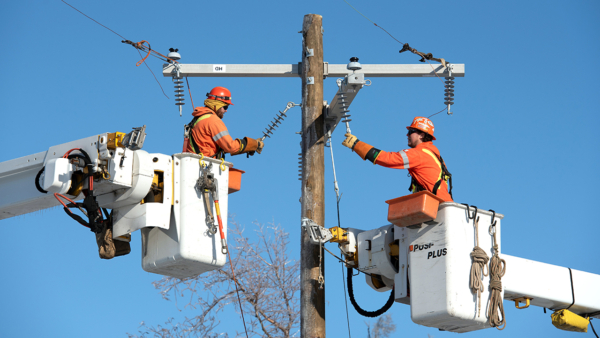
We have continued to make progress today with the challenges of unpredictable ice related hazards, freezing temperatures, high winds, difficult terrain and more, restoring service for more than 90% of our customers.
Gusty winds continue to impact customers across Mississippi into the evening. For the safety of our crews, we cannot use our bucket trucks until sustained winds are less than 30 mph.
In addition to the dangerous cold, these winds were strong enough to damage trees, especially those already weakened or damaged by the recent ice storm. The remaining power restoration efforts were also complicated by the high winds expected today for customers currently without power. Additionally, with temperatures continuing to drop below freezing overnight, there is a threat of refreezing on untreated surfaces, which could hamper traveling until roads thaw. Our teams are monitoring and prepared to respond.
Damage assessment of our distribution facilities is complete, and we are utilizing some of these resources for additional outages that may have occurred throughout the day. As of 6 p.m., We have found approximately 1.53 million feet of downed wires, and damages to about 1,390 poles, 320 transformers and 800 cross arms.
In the most heavily impacted and hard-to-access areas, crews discovered damage caused by fallen trees in addition to the already significant totals identified during initial assessments. These restorations are extremely labor- and time-intensive, often requiring specialized off-road equipment and the replacement of multiple poles and spans.
As of 7:00 p.m., we have a little over 9,513 customers without power. Winds contributed to additional outages occurring overnight and today which are included in the current outage count. Over the course of the winter storm and restoration, there have been about 87,000 individual outages in Mississippi and we have restored about 77,000 customers to date.
If power has been restored in your area and you are without power, check for damage to the electrical equipment attached to your home or business. If your power is out and your electric equipment appears undamaged, call 1-800-9OUTAGE, 1-800-968-8243. Please remember, Entergy restoration workers cannot restore power to a location with a damaged meter base, conduit or weather head (the metal pipe extending upward from the structure with electrical cables inside). These items must be repaired by a qualified electrician before our workers can restore power. Learn more about the electrical equipment that serves your home.
Our crews are staying safe, working in extremely hazardous conditions as they continue responding in these hardest hit areas. One of the biggest threats to our crews working on or near a roadway is a vehicle crashing into their work zone. When driving through a work zone, slow down and move to the far lane. If changing lanes is not possible, reduce your speed on approach.
Estimated restoration times are adjusted based upon damage assessments and special equipment needs. This could also be complicated by the high winds today towards any remaining power restoration efforts for customers currently without power. Some customers in the Grenada and surrounding areas may have their outages extend beyond Sunday. For updated estimated restoration times throughout the day, view our outage map at Entergy.com/viewoutages.
As crews complete restoration in one area, they move to support crews in other parts of our service territory. There are now almost 700 lineworkers working in hard-hit areas such as Grenada, Winona and Batesville.
Additionally, the restoration process can be hampered by the surge of instantaneous electrical demand from appliances (heating units, water heaters, etc.) once service is restored. To reduce the potential overloading of protective devices on the electrical system. Entergy asks that you turn off any electrical appliances that can easily be switched to the off position until power is restored.
Live wires can be deadly. Stay away from downed power lines. Call 1-800-9OUTAGE or 1-800-968-8243 to report downed or dangling power lines, damaged or downed poles or other damaged equipment.
Do not trim trees or remove debris on or near downed power lines. Only power company crews or their contractors should remove trees or limbs touching power lines. Again, stay away from downed power lines.
Please keep away from the immediate areas where crews are working. There is always the danger of moving equipment and the possibility of construction materials, limbs or overhead wires falling to the ground.
Approximately 2,800 restoration workers have been engaged to restore service for customers across our service area, including company employees, mutual assistance and contract resources brought on specifically to assist in restoration. Contractors and mutual aid resources are coming from more than 20 states including Alabama, Arkansas, Colorado, George, Kentucky, Louisiana, Maine, Michigan, Minnesota, Missouri, North Carolina, New York, Oklahoma, Pennsylvania, Texas, Virginia, West Virginia, Connecticut, Florida, Illinois, Tennessee and Canada.
Safety is a core value and always comes first. Then, restoring power is the top priority and first order of business. We assemble and organize the workforce needed to restore service safely and quickly to all customers.
Warming centers
As outages occur, restoration may take additional time due to hazardous conditions and increased demand on the system. There are various warming shelters available across our service area for those needing shelter and warmth. We encourage customers to check on their neighbors and monitor the media as well as information from local and state officials to learn more about these resources. Please see a list of some locations within our service area below:
| Local Name | Address | City |
| Old VFW building | 365 HWY 51 N | Batesville |
| Humphreys County Warming Shelter | 417 Silver City Rd | Belzoni |
| Bolivar County Warming Shelter | 114 W. Preston St | Benoit |
| Byram Fire Department | 200 Byram Parkway | Byram |
| Tallahatchie County Safe Room | 100 S Market St Ste A | Charleston |
| Tallahatchie County Safe Room | 100 Market St Ste C | Charleston |
| Tallahatchie County Safe Room | 100 Market St Ste B | Charleston |
| Clarksdale Civic Auditorium | 506 E. 2nd St | Clarksdale |
| Bolivar County Expo Center | 601 1st St | Cleveland |
| Bolivar County Courthouse (Rosedale) | 801 Main St | Cleveland |
| Duck Hill Community Center | 203 Main St | Duck Hill |
| The Sacred Space | 502 N. Broadway St | Greenville |
| Andrew McQueen Civic Center | 200 W. Carrolton St | Greenwood |
| Fire Station #3 | 106 E Claiborne Ave | Greenwood |
| City of Greenwood Senior Citizen Building | 507 Howard Street | Greenwood |
| Grenada Auditorium | 9 N Main Street | Grenada |
| Gunnison Town Hall | 404 Main St | Gunnison |
| Copiah County Safe Room | 1060 Epps Ln | Hazlehurst |
| Gale Center | 2601 Elm St | Hernando |
| Washington County Warming Shelter | 911 East Avenue South | Hollandale |
| Stewpot Community Center | 1100 W Capitol St | Jackson |
| Shower Power | 836 S Commerce St | Jackson |
| Matt’s House Women Shelter | 355 Livingston St | Jackson |
| Billy Brumfield Men Shelter | 1244 S Gallatin St | Jackson |
| Gateway Rescue Mission | 328 S Gallatin St | Jackson |
| Salvation Army | 110 Presto Ln | Jackson |
| Poplar Creek Volunteer Fire Department | 2 Poplar Creek Rd | Kilmichael |
| St. Luke Church Warming Shelter | 202 Highway St | Metcalfe |
| Adams County Safe Room | 323 Liberty Rd | Natchez |
| Southaven Community Safe Room | 7312 Highway 51 N | Southaven |
| White Oak Community Center | 1080 White Oak Rd | Tunica |
| National Guard | 908 Armory Rd | Tylertown |
| Vicksburg City Auditorium | 901 Monroe St | Vicksburg |
| Town of Walls – Town Hall | 9087 Nail Rd | Walls |
| Yazoo County Warming Shelter | 347 N Mound St | Yazoo |
Customers should be especially careful when using a generator.
- Personal generators are very useful following a winter storm, but they also can be hazardous. The primary hazards to avoid when using a generator are carbon monoxide poisoning from toxic engine exhaust, electric shock or electrocution and fire.
- If you choose to use a generator, buy one only from a reputable dealer who can service and maintain the unit.
- Always use portable electric generators in accordance with the manufacturer’s instructions.
- A gasoline engine usually powers stand-alone generators. Use them only in well-ventilated areas. Never use a generator indoors as carbon monoxide from the exhaust is deadly.
- If the generator has panel-mounted electrical receptacles as part of the unit, appliances may be plugged directly into the generator.
- Never connect a generator directly to a building’s wiring without a licensed electrician disconnecting the house wiring from Entergy’s service. Otherwise, it can create a safety hazard for the customer or crews working to restore power. And it may damage the generator or the house wiring.
- Use a licensed electrician to install the necessary equipment should you decide to wire a generator into your home wiring. The equipment should include a switch to transfer the power source between Entergy and the generator.
- The generator should be properly sized for the expected load. For example, a 3-kilowatt generator will produce 3,000 watts. This is enough power for a 1,200-watt hair dryer and a 1,600-watt toaster, with some power left over for a few light bulbs. Plan for additional needs when sizing their generator.
- Consider a generator’s noise pollution as part of your buying decision. The noise may be obtrusive to neighbors without power.
- Commercial customers should consult with an independent engineer or electrician to size the generator, modify wiring and provide for automatic transfer of power during an outage.
- Consult with suppliers, vendors and local electrical utility companies about required permits before starting any work in a home or business.
Powering your medical needs
- When outages strike, we work hard to restore power as quickly and safely as possible to all customers. But we can’t guarantee continuity of service or priority in restoration, and unplanned outages can’t be completely avoided.
- If you have a medical need that requires electricity, make sure you have a plan in case of a power outage.
- While our crews are dedicated to restoring power, it’s your responsibility to have a backup system and plan in place for power outages or other emergencies.
Customers should stay aware and stay safe. The most dangerous part of a storm is often just after it has passed. Hazards are all around us following severe winter weather – from downed electric lines and equipment or personal generator risks.
- Drive only on roadways and bridges that are passable, and if a power line falls on your vehicle while driving, continue to drive away from the line.
- Please be aware that roads may be hazardous or closed during restoration efforts. Road conditions and closure information can be found here for Mississippi.
- Customers can learn more about preparation and safety information on the company’s Storm Center website:
- Verify contact information in your myEntergy account so you receive alerts and notifications.
- Download the Entergy mobile app to report outages and view restoration progress.
- Have an emergency plan and supplies ready in case of outages.
- Follow Entergy on Facebook: @Entergy Mississippi and X: @EntergyMS.
- Several online resources are available to help you stay safe during severe winter weather.
- Hypothermia (abnormally low body temperature) and frostbite are both dangerous conditions that can happen when a person is exposed to extremely cold temperatures. More information on recognizing and preventing these conditions is available from the Centers for Disease Control and Prevention.
- Protect yourself and your loved ones during a winter storm, especially by safely heating and lighting your home, operating a generator safely, and ensuring the warmth of babies and older adults.
- Protect your home and car during a winter storm.
- How to survive a power outage in winter – information from AccuWeather.com on how to stay warm and reduce risk.
- Information from ready.gov – dangers of winter weather, what to do if under a winter storm warning and how to stay safe when winter weather threatens.

