
Energy affordability is not a challenge with a single solution and no one organization can address it alone.
That was a central theme of the recent Entergy Arkansas Affordability Summit, where leaders from utilities, government, community action agencies, nonprofits and philanthropy came together to share ideas, strengthen partnerships and identify practical ways to help Arkansas families access the resources they need.
Organized by Marshunda Jones and Katrina Brown, customer service managers at Entergy Arkansas, the summit brought together organizations that serve many of the same communities and often encounter the same challenges from different perspectives.
The goal was simple: move beyond conversation and find ways to work together to make a meaningful difference.
The summit opened with remarks from Laura Landreaux, president and CEO of Entergy Arkansas, who set the tone for a collaborative conversation about affordability. Arkansas Rep. Jay Richardson, chair of the Arkansas Legislative Black Caucus, added an important public-policy perspective.
Those opening perspectives underscored why bringing diverse partners to the same table matters. By combining experience from the energy sector, government, community organizations and philanthropy, participants were able to look at affordability from multiple angles.
Understanding the challenge
Mollie Palmer, vice president of communications and engagement for the Heart of Arkansas United Way, offered an important reminder about the scope of the challenge.
“In Arkansas, about 16 percent of our population lives below the federal poverty line,” Palmer said. “That’s approximately $33,000 for a family of four right now, which really isn’t much to live on.”
She also emphasized that financial hardship cannot simply be attributed to a lack of effort.
“It’s important for people to understand that this isn’t simply a matter of not working hard enough,” Palmer said. “It’s incredibly difficult to piece together multiple jobs to earn enough income to support a family, let alone have time to rest.”
Her comments reinforced an important point discussed throughout the summit: affordability challenges are complex, and the people experiencing them may not always fit neatly into traditional assistance categories.
“When we bring community partners together, we create more opportunities to understand the challenges families are facing and connect them with meaningful support,” Jones said. “This summit was about turning shared concern into collaboration, action, and lasting impact.”
From conversation to collaboration
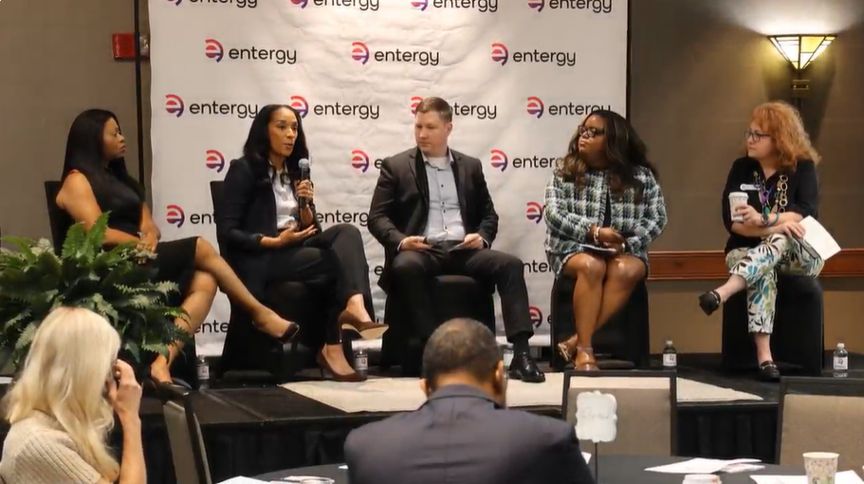
The panel discussion, “Powering Possibility: A Collaborative Approach to Affordability,” was moderated by Brandi Hinkle, senior public affairs representative. Panelists Chris Osbon, Tomekia Moore, Stephanie Garner and Sherra Bennett shared perspectives from utilities, community action, nonprofit leadership and philanthropy.
The conversation focused on strengthening partnerships, improving access to assistance and pursuing sustainable solutions for people experiencing financial challenges.
That shared commitment to finding practical solutions shaped the summit from the start, Brown said.
“So many people are facing financial pressure but may not qualify for traditional assistance, which makes collaboration especially important,” Brown said. “At Entergy, we understand that electricity is a necessity, and we are committed to listening to our customers, connecting people with resources, and working alongside our partners to help communities thrive.”
The summit then moved from discussion to action through three breakout sessions:
- ALICE (Asset Limited Income-Constrained Employed) in Arkansas: Understanding the Data Around Low-Income Working Arkansans examined the financial realities facing working households.
- Start. Stop. Connect.: Reimagining How We Serve challenged participants to identify practices they should begin, discontinue or strengthen through better partnerships.
- From Resources to Results: Building a Stronger Referral Network explored ways to connect people with the right services and make community resources easier to access.
Together, the sessions put data-informed decision-making, practical collaboration and stronger referral pathways at the center of the conversation.
Walking in someone else’s shoes
Perhaps the most eye-opening exercise of the day was a modified poverty simulation designed to help participants better understand the realities many families face.
Participants anonymously answered 30 yes-or-no questions, including whether they had ever had their utilities shut off or whether their family owned a summer home or second house. After completing the questions, participants crumbled their sheets, tossed them into a pile and randomly selected another person’s responses.
A facilitator then sorted the group according to a scoring system, with higher scores representing greater levels of poverty.
The result was striking: At the end of the exercise, only two of approximately 90 participants had never experienced the types of hardships reflected in the simulation.
The exercise provided a powerful reminder that financial hardship can affect people in ways that may not always be visible and that understanding those experiences is an important part of developing better solutions.
Turning ideas into action
Throughout the day, drawings were held for $1,000 micro-grants, providing a total of $5,000 to nonprofit organizations.
The grants connected the day’s conversations to tangible community investment while recognizing the critical role nonprofits play in reaching families, responding to local needs and delivering essential services.
But the work doesn’t end with the summit.
By bringing together people who work with Arkansas families every day, the event created an opportunity to build relationships that can continue long after the gathering ended.
“The work does not end when the summit is over,” Jones said. “The next step is carrying these conversations forward and continuing to build the connections that help our communities thrive.”
That may be the most important takeaway of all: Advancing affordability is a shared responsibility.
When organizations listen to one another, share resources, understand the data and build stronger pathways to assistance, they can move closer to solutions that help more Arkansas families and create lasting impact in the communities they serve.

