
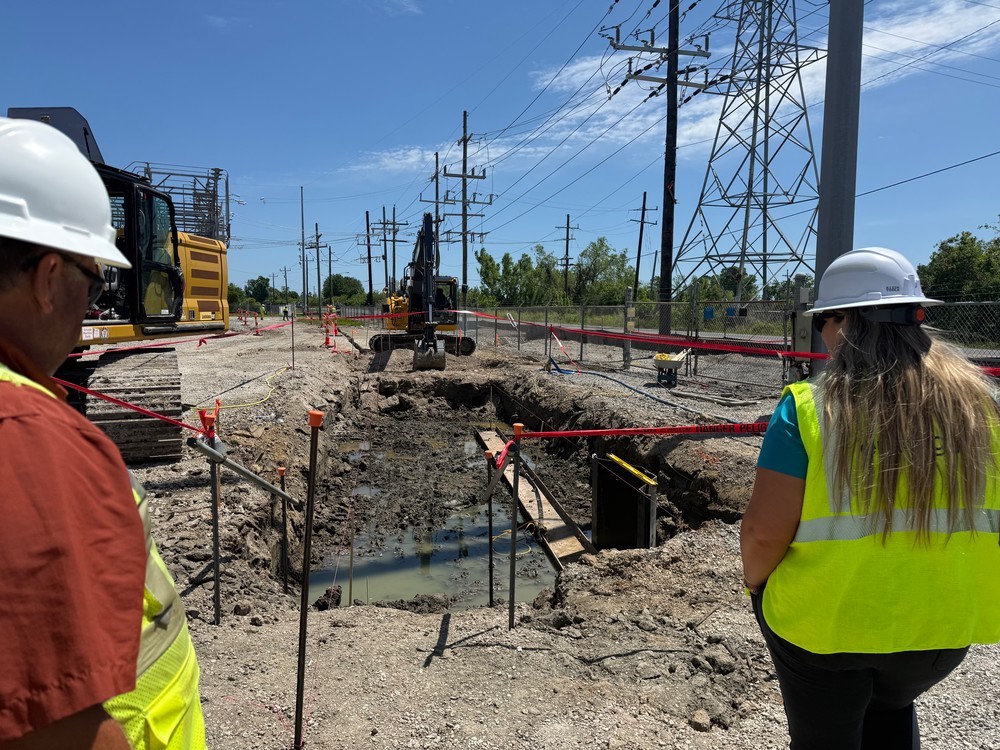
In south Louisiana, where storms are a fact of life and water rarely asks permission, protecting the power grid means planning for every scenario — including what happens when the water rises?
In Lockport, crews are building a reinforced flood wall around the Valentine substation, the first of five projects like it planned across the state. Substations are a critical piece of infrastructure that most people pass every day without a second thought. It doesn’t generate electricity. It doesn’t power your home directly. But without it, the lights don’t come on.
A substation is where electricity shifts from long-distance travel to local delivery. Power moves across the grid at high speed and high voltage, but it can’t go straight into homes that way. At a substation, it’s stepped down to safer levels and redirected so it can be distributed to homes, schools, hospitals, and businesses. Think of it like cars leaving the interstate, slowing down, and branching off onto neighborhood streets.
That’s what makes substations essential and so vulnerable.
Flooding is one of the biggest threats to this equipment. Substations sit close to the ground and rely on highly sensitive components like transformers, breakers and control systems. When water gets into those systems, it can cause immediate outages, long-term damage, or even complete equipment failure. In severe cases, a flooded substation can take thousands of customers offline in an instant and keep them in the dark for days or weeks while repairs are made. And those repairs aren’t cheap.
Replacing major substation equipment can cost millions of dollars. Add in emergency response, extended outage restoration and lost economic activity for businesses, and the price climbs even higher.
That’s where the flood wall comes in.
Engineered to surround the substation and hold back rising water during heavy rain events and storm surge, the wall acts as a physical barrier between critical equipment and the elements. It’s designed based on historical flood data, future storm projections, and elevation levels to ensure it can withstand the kind of extreme weather Louisiana knows all too well.
It’s not flashy. It won’t make headlines on a blue-sky day. But when the next storm rolls in, it could be the difference between a community that stays powered and one that goes dark. More importantly, it’s a smart financial decision.
Investing upfront in resilience, like a flood wall, is significantly less expensive than rebuilding after a disaster. By preventing damage, utilities avoid costly repairs and reduce the need for emergency measures, which helps keep electricity rates more stable over time. In other words, protecting infrastructure today helps protect customers’ wallets tomorrow.
There’s also a reliability factor that’s harder to measure but just as important. Keeping substations online during storms means fewer outages, faster recovery times and greater confidence for businesses considering investment in the region.
In a state where water shapes both the landscape and the economy, projects like this are about more than infrastructure. They’re about foresight — recognizing risks before they become failures, and building systems strong enough to withstand what’s coming next.
Because in Louisiana, resilience isn’t optional. It’s the foundation everything else depends on.

