
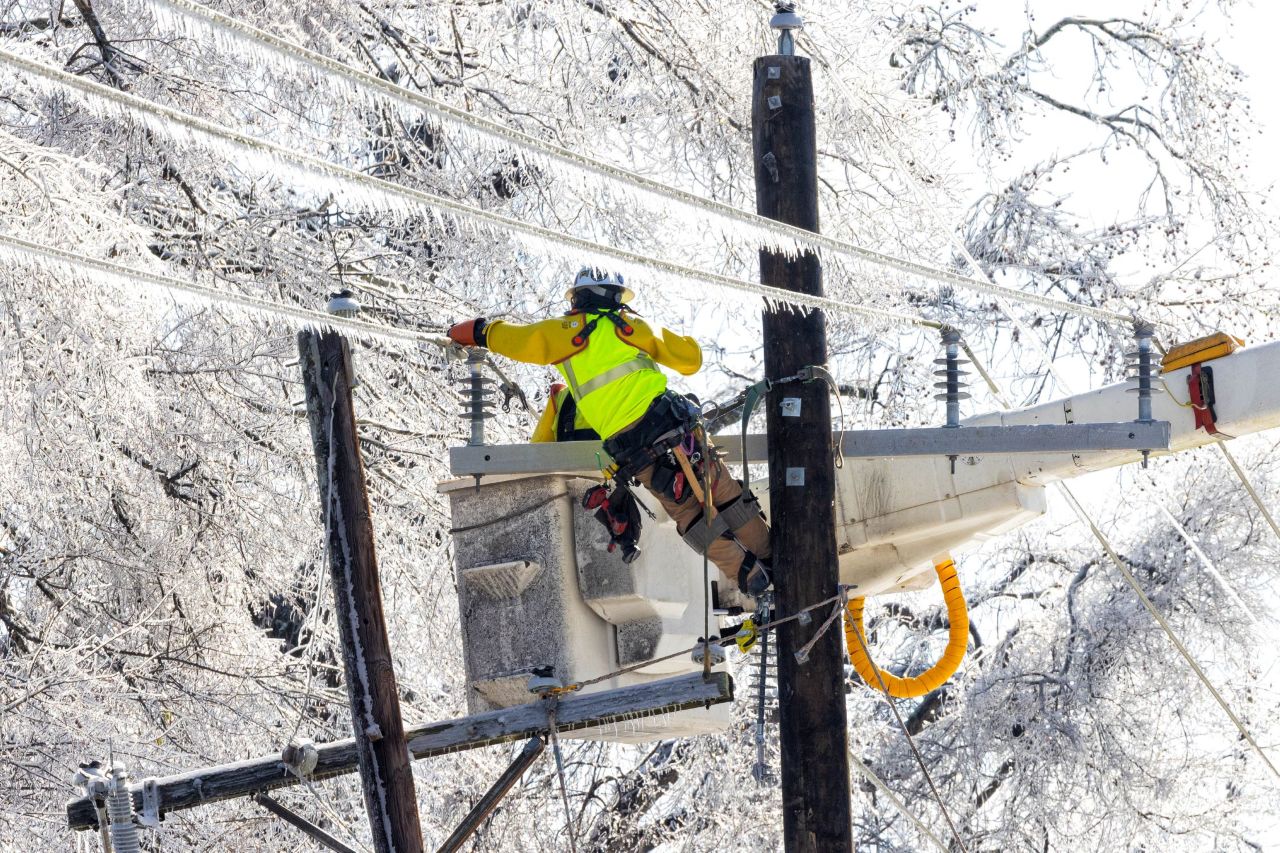
Entergy lineworker Derek Mayo wakes at 5 a.m.
His bunk is frigid, just a tick below 20-degrees outside his trailer, and his feet are freezing. He wearily loads up his gear, including extra socks for when his first pair get too wet in the snow and ice, and saunters over to his team’s morning safety briefing.
“It’s the worst ice storm any of us have ever seen,” says Mayo. “The conditions are so, so harsh. It’s freezing cold and everything just moves slower.”
Mayo and his team load up their bucket truck before the sun rises with their supplies for the day, including a lunch that will sit for the better part of five hours before they have a chance to take a bite. The doors to the truck are frozen shut, the only access coming by way of a lighter to melt the ice that settled into the crevasses overnight.
Once the team buckles in, the truck needs a minute before it agrees to move down the road. The brakes and hydraulics are frozen and need to be warmed up if they want to make it to their first job site of the day.
Things don’t get quicker from there.
The roads are iced over and traffic bogs down progress, creeping along to their destination with the end goal of restoring power to the nearly 92,000 customers who lost service in Northern Louisiana, a seemingly impossible task from his viewpoint. Chains on the tires intended to help grip the slick roadways break often in the slurry of mud and ice.
“They’re helpful to a point,” adds Mayo. “But you won’t be getting anywhere fast, and we have to stop every-so-often to put them back on the tires after they pop off.”
The team almost makes it. The truck hits an impasse in the ice. Luckily, a nearby neighbor sees the issue and has just the ticket: a bulldozer that can give the stuck bucket an extra bit of encouragement in the right direction.
Donned in heavy, stiff, cold-weather gear, they begin the process of replacing poles, wires and transformers. Truck bins are again frozen shut and the lighter has to make its second appearance of the day so the crew can access the necessary equipment.
They roll off the track machine, a specialized all-terrain vehicle that can access the backyards they need to get to in order to make repairs.
“Just something simple like turning a wrench takes 10-times longer than it normally would,” said Mayo. “Everything is just ice cold; your fingers are so numb you can barely move, and your feet feel like they’re stuck in blocks.”
Finally done replacing the pole, it’s on to the next one. While the repair is solid, too much ice can impede the flow of electricity no matter how much care is taken in replacing the wires. The day heats up, and the ice begins to melt, causing the track machine to now be bogged down in thick, rich north-Louisiana mud. But Mayo and his team find a way, just as they did yesterday, and the day before that.
“You just can’t imagine what it looks like unless you’re out here,” he said of the harsh conditions. “You’re in the air and all around you can hear ice breaking and branches snapping. This job is dangerous enough, now there’s this whole other element and a whole new set of overhead hazards we have to keep in mind as we’re working.”
Jobs completed, the group now reverses course and heads back. Traversing the same conditions that gave them fits earlier that morning. Exhausted, joints aching and tire chains breaking.
Back at the staging site Mayo grabs a dinner, showers, drops off his mud-laden laundry and finally has a chance to rest his feet after a grueling 16-hour shift. His head hits the pillow sometime after 11 p.m., only to wake and begin again the next morning.
Mayo is one of more than 4,000 men and women on the ground working to restore power to North Louisiana, because that’s what linemen do.
“Be patient,” he asks. “Please stay off the roads and be kind, we’re trying the best we can.”

