
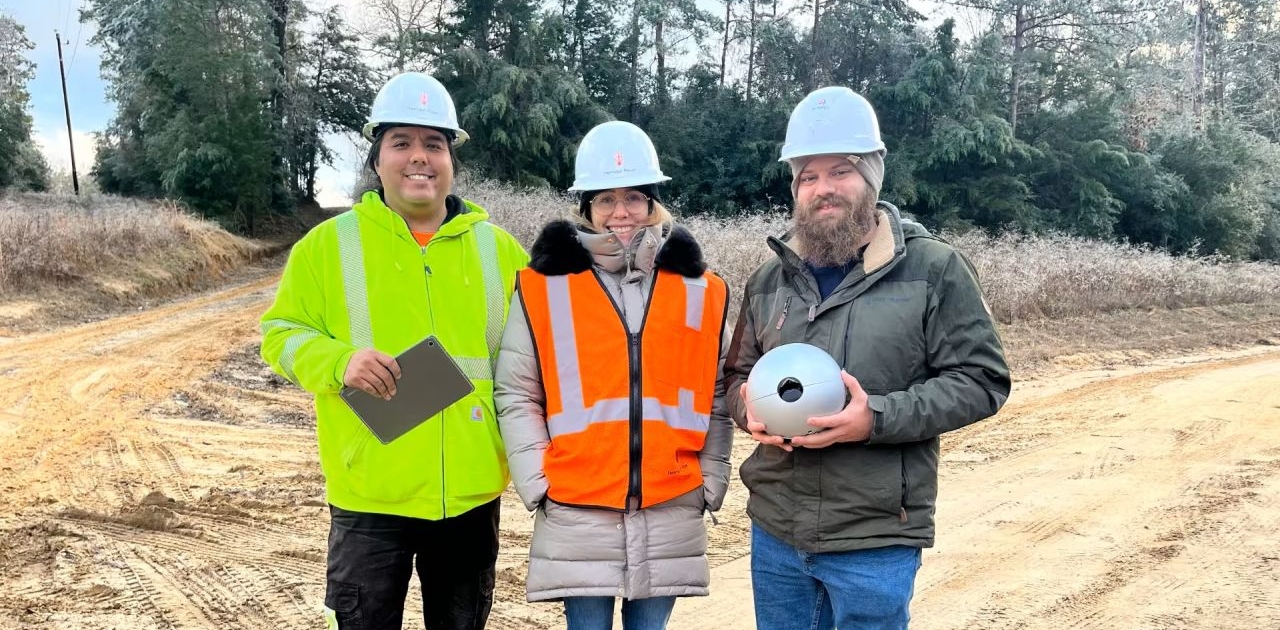
Pictured: Jonathan McGinnis, project manager for Heimdall Power; Ann Charlotte Valheim, chief deployment officer, Heimdall Power; and Tim Sansing, senior engineer, Entergy
What if more electricity could safely move across some existing transmission lines without the immediate need for building new ones? That’s the opportunity behind advanced transmission technology being deployed across Arkansas, Louisiana and Mississippi — and one of the most innovative parts of the project arrives by drone.
Through a $13.7 million U.S. Department of Energy award, this project will deploy dynamic line rating technology and other grid improvements across 1,125 miles of existing transmission lines. The goal is to , reduce congestion and strengthen the grid as communities across our region continue to grow. DLR has been around for decades, but advances in technology have made it more practical and scalable.
Katie Jereza, assistant secretary for the U.S. Department of Energy’s Office of Electricity, joined Entergy leaders in Mississippi this week for a project tour and press conference.
“DLR is not a new concept, but the installation method and how we go about deploying this is the new piece of it that finally makes it something that people can see the benefit and actually get behind,” said Tim Sansing, senior engineer for technology development and analytics.
At the center of the effort are small sensors attached directly to transmission lines that provide live information about conditions such as temperature, wind speed, solar radiation, conductor temperature and line sag.
“DLR gives us real-time insight into how much electricity a line can safely carry under actual weather conditions, helping us move more energy across the grid using existing infrastructure,” Sansing said.
One way to further understand DLR is to compare it to a highway. Drivers follow a posted speed limit because it provides a safe operating standard, but conditions such as weather can change from one day to the next. Similarly, DLR provides additional information about real-time conditions on a transmission line, giving operators greater visibility into how much capacity may be available at a given time while maintaining safety and reliability.
One of the most innovative aspects of the project is the way sensors are installed. Instead of relying on a bucket truck, an outage or extensive manual work, an autonomous drone carries each sensor to the transmission line. Using LiDAR technology, the drone identifies the conductor and completes the installation in less than two minutes. That approach is especially valuable when deploying more than 600 sensors across 1,100-plus miles of transmission lines, including in rural and difficult-to-access areas.
The technology also provides greater visibility into portions of the transmission system that historically has had less real-time information available. As this technology develops, the sensors could support additional capabilities, including wildfire detection and connections to other devices such as cameras. While the drone may be the most visible part of the project, the larger opportunity is making better use of existing infrastructure as electricity demand grows across our region, including new industrial development, manufacturing and data centers.
Increasing capacity on existing lines could help defer some future transmission investments, which can take years to plan and build, while providing operators with more information to manage changing conditions across the system.
“We’re doing everything we can to keep the cost down for customers and be able to get the most that we can out of what we have today, rather than having to rely on new builds,” Sansing said.
The project also includes targeted substations and terminal upgrades designed to help maximize the benefits of the technology where existing equipment could otherwise limit capacity.
Ultimately, the goal is to use innovation to make better use of infrastructure already in place, strengthen the grid and support the communities and industries that depend on reliable electricity. Sometimes, that innovation takes flight.

