Data centers and Entergy
Know the facts

Know the facts
Any time economic developments of this scale are announced, there are bound to be questions about the impact on residents, and information being shared by outside parties is not always correct or applicable to a specific project.
To get an accurate picture of how a data center development on your state’s grid will impact your electric service and bills, it’s important to be able to separate fact from fiction. Check out the resources below to learn more about how we are ensuring that the data centers we power are creating savings and benefits for all our customers.
The economic and community benefits of the data center projects we serve are expected to be transformative for their states. The projects we secured between 2024 and 2025 alone are expected to generate approximately $49 billion in total new investment for communities in the region, thousands of high-tech jobs, millions of dollars in new tax revenues, improved local infrastructure, spin-off new business and employment opportunities, and a substantial influx of new philanthropic support for schools, non-profits, low-income families, workforce development and other state and community needs.
Millions of customers, regardless of whether they live near the data center facilities, will benefit from them joining our grid, including new projects to strengthen the overall energy grid, reduced bill impacts from those grid infrastructure projects, residential customers paying a smaller share of the cost for new power generation facilities and lower bill fees for storm recovery work.
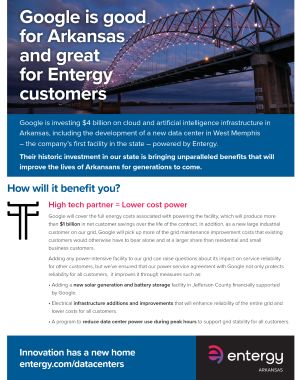
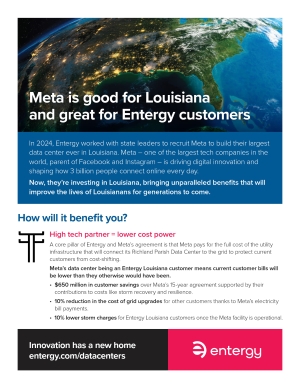
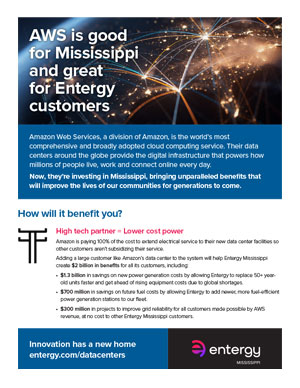
High-tech partners = Lower cost power
Data center customers are paying to connect their facilities to our grid. There is no mark-up cost to customers on the service we provide, including any charges for purchasing fuel to power our plants. In addition, new large industrial customers help pick up a larger share of the grid maintenance improvement costs that residential and small business customers would otherwise have to bear alone. The data center projects that we agreed to power between 2024 and 2025 alone are generating an estimated $7 billion in total savings for 2.3 million customers in Arkansas, Louisiana and Mississippi because of data center customer agreements in those states.
Infrastructure improvements that benefit all customers
The large amounts of electricity these data center facilities require has raised questions nationally about how that will impact the price and reliability of power for existing electric customers.
We enter into thoughtful data center customer service agreements that require them to pay the direct power costs to serve their facilities and provide added benefits for existing customers. Additionally, the state public service commissions for Arkansas, Louisiana and Mississippi have exercised oversight to ensure these and future data center projects do not negatively impact electric customers in their states who are sharing the same power grid.
In addition, new large industrial customers help pick up a larger share of the grid maintenance improvement costs that residential and small business customers would otherwise have to bear alone. For example, in Arkansas, Google has agreed to support the construction of a new 600-megawatt solar and 350-megawatt battery facility that will further diversify Entergy Arkansas’s power portfolio, which will provide power to all customers. And Entergy’s Superpower Mississippi plan will deliver $300 million in new grid improvements at no additional cost to Entergy Mississippi customers because of new revenues from Amazon and other large industrial customers’ investments in the state.
New jobs and economic opportunities for our states
The decisions of these global tech giants to establish their new operations in the Gulf South region cast a new and brighter economic development spotlight on our states, helping them become preferred destinations for a new wave of high-tech industries.
The presence of such large operations in the states we serve will also bring new resources to support and uplift our communities, now and for generations to come. For example, Meta’s Richland Parish Data Center project is creating $200 million in investments to improve infrastructure including roads and water systems to support both its facility and the surrounding community.
Projects of this scale also produce billions in economic impact dollars that go back into their local communities, including millions in new state and local tax revenue that will bolster investments in infrastructure and public services like roads, hospitals and schools. These investments also generate high-paying job opportunities, training for individuals so that they can qualify for those new positions, and workforce development.
For example, Amazon’s planned $10 billion data center investment is estimated to generate $30 billion toward the state of Mississippi’s gross domestic product.
Increased community investment and charitable giving
These companies are also committed to investing in the people and communities in which they are located – better workforce development and training resources, investments in STEM education, and charitable contributions that directly serve residents.
For example, as part of our service agreement, Meta has pledged to annually match $120 million for The Power to Care, our bill payment assistance program for vulnerable customers, and to provide funds to improve educational resources in the state of Louisiana through its Data Center Community Action Grant program. Additionally, $140 million for energy efficiency initiatives for vulnerable customers will support these communities in reducing their energy consumption and costs.
Q: Will a data center being built in my state and powered by Entergy make my electricity bills go up?
A: No. New large industrial customers help pick up a larger share of the grid maintenance improvement costs that residential and small business customers would otherwise have to bear alone. Data center customers are also paying the cost to connect their facilities to our grid. There is no mark-up cost to customers on the service we provide, including any charges for purchasing fuel to power our plants.
While data centers may use a higher level of electricity in their day-to-day operations than most, they pay directly for the power they use. Some data center customers even prepay some of their cost of service as part of the service agreement with Entergy, generating even more savings for other customers. The data center customer agreements that we signed between 2024 and 2025 alone are generating an estimated $7 billion in total savings for our 2.3 million customers in Arkansas, Louisiana and Mississippi.
Q: Will a data center being built in my state and powered by Entergy negatively impact grid reliability, increase outages or make my electrical service worse?
A: No. The presence of data centers on our grid will not negatively impact reliability or service for other customers. The infrastructure improvements being made and additional generation resources being added to the grid to power these facilities will actually improve systemwide grid reliability. Maintaining grid reliability and power quality are core guiding principles in our Fair Share Plus pledge to our customers. Data centers need a large amount of electricity to operate, but before agreeing to power The presence of data centers on our grid will not negatively impact reliability or service for other customers. The infrastructure improvements being made and additional generation resources being added to the grid to power these facilities will actually improve systemwide grid reliability. Maintaining grid reliability and power quality are core guiding principles in our Fair Share Plus pledge to our customers. Data centers need a large amount of a new facility, we work extensively with the new data center customer to ensure that enough new power generation capacity and appropriate transmission upgrades will be added to the system to reliably supply additional demand on the grid while maintaining reliable service to our existing customers.
The fact that Entergy is a fully regulated public utility means that all major changes to our system and investments in our grid must comply with strict regulations. While some of the terms of these new data center customers’ service agreements are competitively sensitive to the customer and not publicly disclosed, utility regulators are able to review and evaluate all these terms. This extensive regulation is designed to ensure transparency and customer protections, for example, maintaining rates below the national average and ensuring continued reliable service.
And the additional revenue from sales of electricity to these new customers will provide us with more resources and financial flexibility to invest in the reliability of our electric system, such as hardening infrastructure like poles and lines to withstand more severe weather and adding new technological innovations like self-healing networks to the grid that benefit all customers.
Q: Could a data center customer change its mind and abandon its project in my state after Entergy has spent millions of dollars to build new generation capacity and infrastructure for them, leaving residents on the hook for the cost without delivering any of the benefits?
A: No. Each Electric Service Agreement between one of our operating companies and an industrial customer like a data center is unique, and the terms are competitively sensitive to the customer and therefore confidential. Our Fair Share Plus pledge to our customers, however, includes guiding principles to ensure our data center service agreements include safeguards for our other customers, including sufficiently long contract terms, strong collateral requirements, and guaranteeing adequate revenue from the data center. Regulators oversee these arrangements to ensure that the interests of all customers are protected.
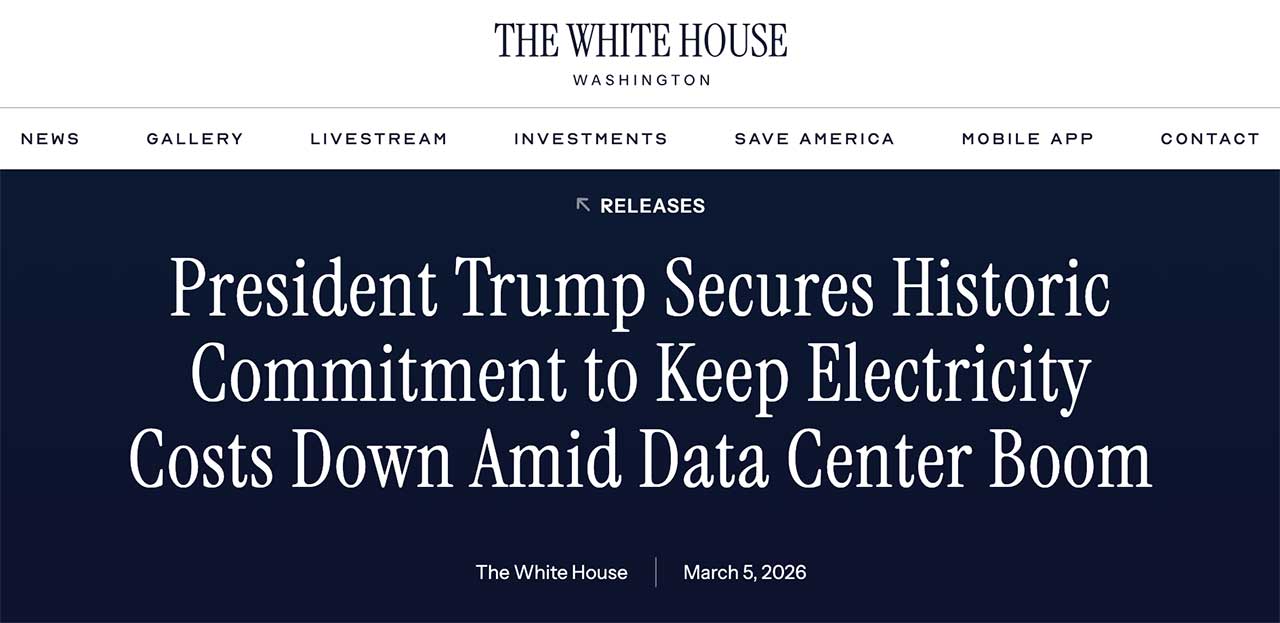
Read the press release from the White House that quotes Entergy Chair and CEO Drew Marsh.

Data centers and
Entergy

Our Fair Share
Plus Pledge

Data centers and
Entergy Arkansas

Data centers and
Entergy Louisiana

Data centers and
Entergy Mississippi
 https://www.entergy.com/wp-content/uploads/2026/07/AMZ-sustainability.jpg
530
1192
Caron Blanton
https://www.entergy.com/wp-content/uploads/2024/06/EntergyLogo_340x156.png
Caron Blanton2026-07-10 14:27:062026-07-10 14:27:06FAQ: Are Amazon data centers raising electricity bills?
https://www.entergy.com/wp-content/uploads/2026/07/AMZ-sustainability.jpg
530
1192
Caron Blanton
https://www.entergy.com/wp-content/uploads/2024/06/EntergyLogo_340x156.png
Caron Blanton2026-07-10 14:27:062026-07-10 14:27:06FAQ: Are Amazon data centers raising electricity bills? https://www.entergy.com/wp-content/uploads/ELL-skyline-logo.png
720
1280
Phillip May
https://www.entergy.com/wp-content/uploads/2024/06/EntergyLogo_340x156.png
Phillip May2026-06-25 15:05:032026-06-25 19:09:13Phillip May, president and CEO, Entergy Louisiana – Supporting strong protections for customers as state sets clear path for data center growth
https://www.entergy.com/wp-content/uploads/ELL-skyline-logo.png
720
1280
Phillip May
https://www.entergy.com/wp-content/uploads/2024/06/EntergyLogo_340x156.png
Phillip May2026-06-19 17:02:202026-06-23 22:40:49Statement from Phillip May, President and CEO, Entergy Louisiana
https://www.entergy.com/wp-content/uploads/ELL-skyline-logo.png
720
1280
Phillip May
https://www.entergy.com/wp-content/uploads/2024/06/EntergyLogo_340x156.png
Phillip May2026-06-25 15:05:032026-06-25 19:09:13Phillip May, president and CEO, Entergy Louisiana – Supporting strong protections for customers as state sets clear path for data center growth
https://www.entergy.com/wp-content/uploads/ELL-skyline-logo.png
720
1280
Phillip May
https://www.entergy.com/wp-content/uploads/2024/06/EntergyLogo_340x156.png
Phillip May2026-06-19 17:02:202026-06-23 22:40:49Statement from Phillip May, President and CEO, Entergy Louisiana https://www.entergy.com/wp-content/uploads/2026/05/Data-Center-Website.jpg
716
1020
Lamor Williams
https://www.entergy.com/wp-content/uploads/2024/06/EntergyLogo_340x156.png
Lamor Williams2026-05-20 11:04:272026-05-26 09:04:44Little Rock Regional Chamber, Entergy Arkansas, Central Arkansas Water, and Little Rock Water Reclamation Authority announce resource site for data center facts
https://www.entergy.com/wp-content/uploads/2026/05/Data-Center-Website.jpg
716
1020
Lamor Williams
https://www.entergy.com/wp-content/uploads/2024/06/EntergyLogo_340x156.png
Lamor Williams2026-05-20 11:04:272026-05-26 09:04:44Little Rock Regional Chamber, Entergy Arkansas, Central Arkansas Water, and Little Rock Water Reclamation Authority announce resource site for data center facts https://www.entergy.com/wp-content/uploads/2026/04/021A8144-scaled.jpg
1445
2560
Claire Kreuz
https://www.entergy.com/wp-content/uploads/2024/06/EntergyLogo_340x156.png
Claire Kreuz2026-04-29 08:59:352026-05-20 13:52:17Entergy Arkansas, Google and ICF partnership helps unlock energy savings for Crittenden County residents
https://www.entergy.com/wp-content/uploads/2026/04/021A8144-scaled.jpg
1445
2560
Claire Kreuz
https://www.entergy.com/wp-content/uploads/2024/06/EntergyLogo_340x156.png
Claire Kreuz2026-04-29 08:59:352026-05-20 13:52:17Entergy Arkansas, Google and ICF partnership helps unlock energy savings for Crittenden County residents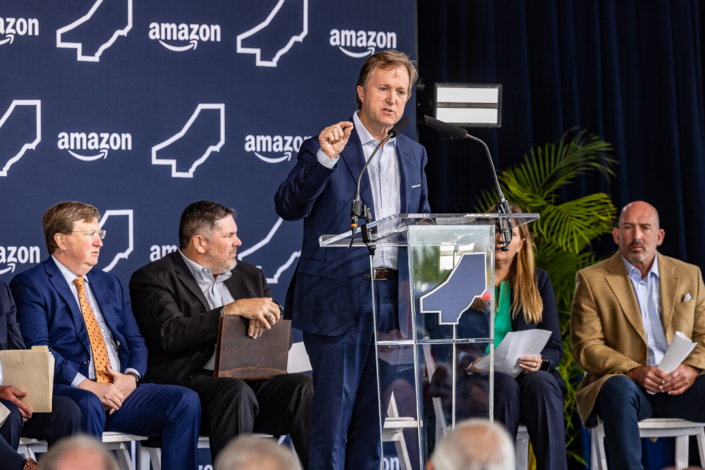 https://www.entergy.com/wp-content/uploads/2026/04/Haley_BEK5513.jpg
720
1079
Mississippi Team
https://www.entergy.com/wp-content/uploads/2024/06/EntergyLogo_340x156.png
Mississippi Team2026-04-09 15:01:472026-04-22 23:22:29Amazon expands, and Entergy Mississippi stands ready to deliver benefits for all our customers
https://www.entergy.com/wp-content/uploads/2026/04/Haley_BEK5513.jpg
720
1079
Mississippi Team
https://www.entergy.com/wp-content/uploads/2024/06/EntergyLogo_340x156.png
Mississippi Team2026-04-09 15:01:472026-04-22 23:22:29Amazon expands, and Entergy Mississippi stands ready to deliver benefits for all our customers