
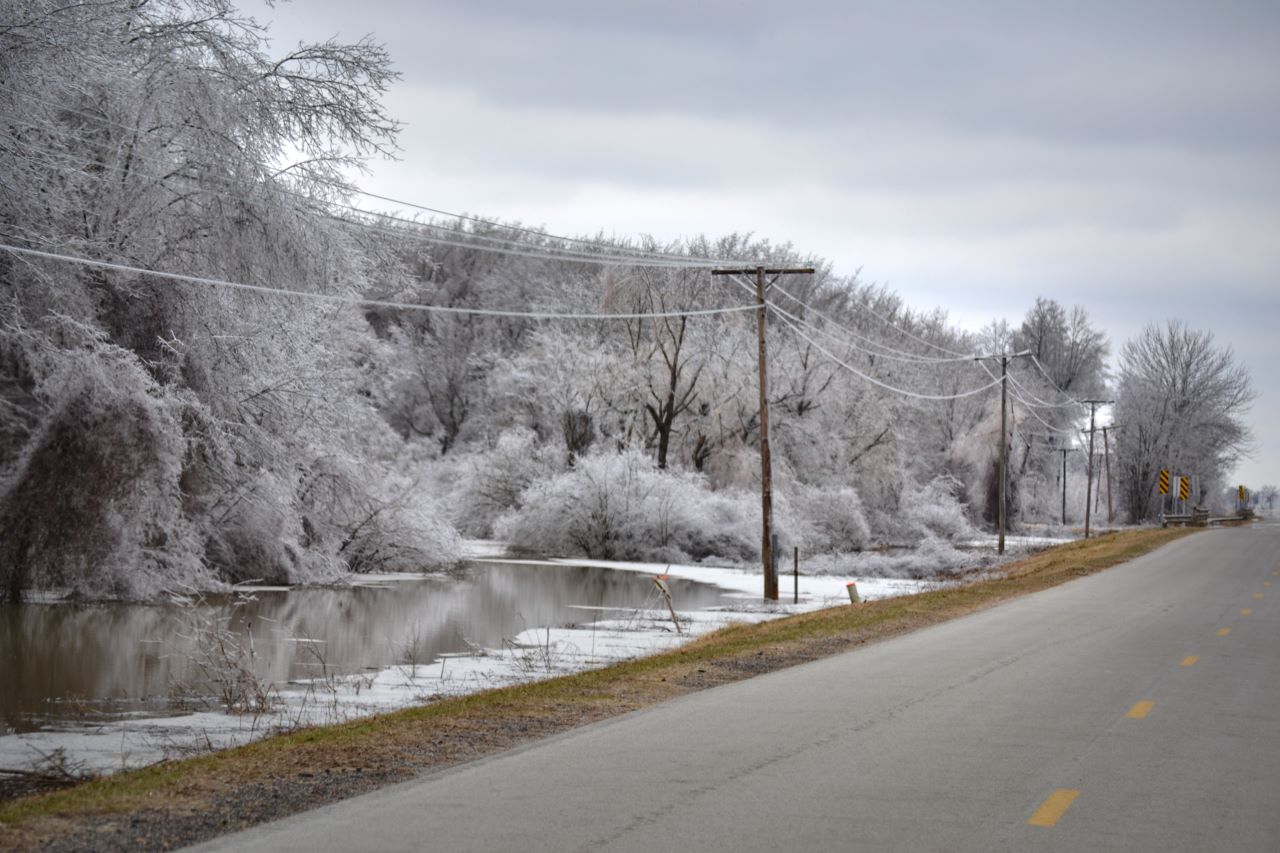
Winter weather continues to pass through our service area, bringing snow and ice to some of the communities we serve. Where possible, crews have begun restoring power to customers who lost service, but continued icy conditions may delay crews from safely getting to work. Our crews are staying safe and ready to respond as soon as the weather improves.
- Safety is a core value and always comes first. Then, restoring power is the top priority and first order of business. We assemble and organize the workforce needed to restore service safely and quickly to all customers.
- At 7 a.m., approximately 71,095 customer outages occurred including:
- Arkansas – 340
- Louisiana – 53,345
- Mississippi – 14,690
- Texas – 2,720
- These figures may include outages not related to the storm.
- We currently have more than 10,000 restoration workers in place or mobilizing to restore service for customers across our service area, including 4,900 mutual assistance and contract resources brought on specifically to assist in restoration. These resources include company employees, contractors and mutual aid resources numbering approximately:
- 3,715 in Arkansas
- 2,750 in Louisiana (including the New Orleans area)
- 2,940 in Mississippi
- 660 in Texas, which is projected to have lower damages.
- As inclement weather persists, customers should take safety precautions as extremely cold weather is forecasted for multiple days into early next week. Keep in mind that it could take several days to complete the restoration of power outages caused by this storm.
- The forecast continues to call for more than a 1/2 inch of ice in several areas, plus snow and freezing rain in parts of our service territories. Historical storm data suggests this winter weather event could cause widespread and extended power outages across an unusually broad multi-state area.
- Accessibility challenges such as icy road conditions and freezing temperatures may affect our ability to reach some areas of our territory and could delay damage assessment and restoration in those communities.
- There are various warming centers open across Arkansas, Mississippi, North Louisiana and Texas for those in need of shelter and warmth. Customers are encouraged to tune into their local media stations for more information.
Our crews are prepared to work long hours after the storm has passed, restoring service to customers as safely and as quickly as possible.
- We are actively securing workers to assist in restoration efforts from around the country. However, given the large footprint of the storm across the region, securing these additional assets may prove more difficult than normal.
- Restoration workers are coming from more than 20 states including Alabama, Arkansas, Colorado, Georgia, Kentucky, Louisiana, Maine, Michigan, Minnesota, Missouri, North Carolina, New York, Oklahoma, Pennsylvania, Texas, Virginia, West Virginia, Connecticut, Florida, Illinois, Tennessee and Canada.
The impact of ice storms is very difficult to predict, and ice is particularly harmful to electrical lines.
- Freezing rain and snow can be very unpredictable, and location matters greatly. During freezing rain events, variations in rainfall amounts can result in severe damage in one area while nearby areas are only slightly affected.
- Predicting outages caused by winter storms is challenging. Areas of freezing temperatures and precipitation can vary widely, with just a few degrees of difference between what’s predicted and what actually happens.
- If outages occur, we ask for patience, as restoration may take longer due to icy conditions that can delay crews from safely getting to work.
- Freezing rain sticks to power lines in a very small temperature range (2 or 3 degrees, just below freezing).
- Ice is particularly harmful to electrical lines:
- Ice can increase the weight of branches by 30 times.
- At 1/8 inch of freezing rain accumulation, small limbs and lines become coated and can cause isolated outages by breaking the weakest limbs that are overhanging services and lines.
- At 1/4 inch of freezing rain accumulation, more limbs and lines become coated in ice. Younger evergreen trees will start to become so heavy they may lean into the distribution lines, causing isolated power outages.
- A 1/2 inch accumulation on power lines can add 500 pounds of extra weight. A large percentage of deciduous tree limbs will break and the tops of evergreen trees may break out, falling on distribution lines. On longer spans, the weight of ice on the conductors may be enough to break the lines without limbs falling on them. Crossarms may break and pole tops may break out as limbs hit the lines attached to them. Poles supporting large power equipment (i.e transformers, regulators) may be more susceptible to breakage. As ice accumulates on trees and power lines widespread power outages can occur.
- At 3/4 inch of freezing rain accumulation, almost all deciduous tree limbs will break and the tops of evergreen trees will break out, falling on distribution lines. On medium and longer spans, the weight of ice on the conductors will be enough to break the lines without limbs falling on them. Many crossarms will break and pole tops will frequently break out as limbs hit the lines attached to them. Many transformers will fall with these pole tops.
- At 1 inch of freezing rain accumulation and above, substantial devastation of the overhead distribution system will occur. The accumulation of ice can result in long power outages and the transmission system may start having significant trouble as well.
- More than 1 inch of ice accumulation is very destructive to distributions lines and transmissions systems. This severity of ice accumulation also causes significant tree damage. The impact can result in long power outages.
Customers should stay aware and stay safe.
- The most dangerous part of a storm is often just after it has passed. Hazards are all around us following severe winter weather – from downed electric lines and equipment or personal generator risks.
- Drive only on roadways and bridges that are passable, and if a power line falls on your vehicle while driving, continue to drive away from the line.
- Please be aware that roads may be hazardous or closed during restoration efforts. Road conditions and closure information can be found here for Arkansas, Louisiana, Mississippi, and Texas.
- Customers can learn more about preparation and safety information on the company’s Storm Center website,
- Several online resources are available to help you stay safe during severe winter weather.
- Hypothermia (abnormally low body temperature) and frostbite are both dangerous conditions that can happen when a person is exposed to extremely cold temperatures. More information on recognizing and preventing these conditions is available from the Centers for Disease Control and Prevention.
- Protect yourself and your loved ones during a winter storm, especially by safely heating and lighting your home, operating a generator safely, and ensuring the warmth of babies and older adults.
- Protect your home and car during a winter storm.
- How to survive a power outage in winter – information from AccuWeather.com on how to stay warm and reduce risk.
- Information from ready.gov – dangers of winter weather, what to do if under a winter storm warning and how to stay safe when winter weather threatens.

