
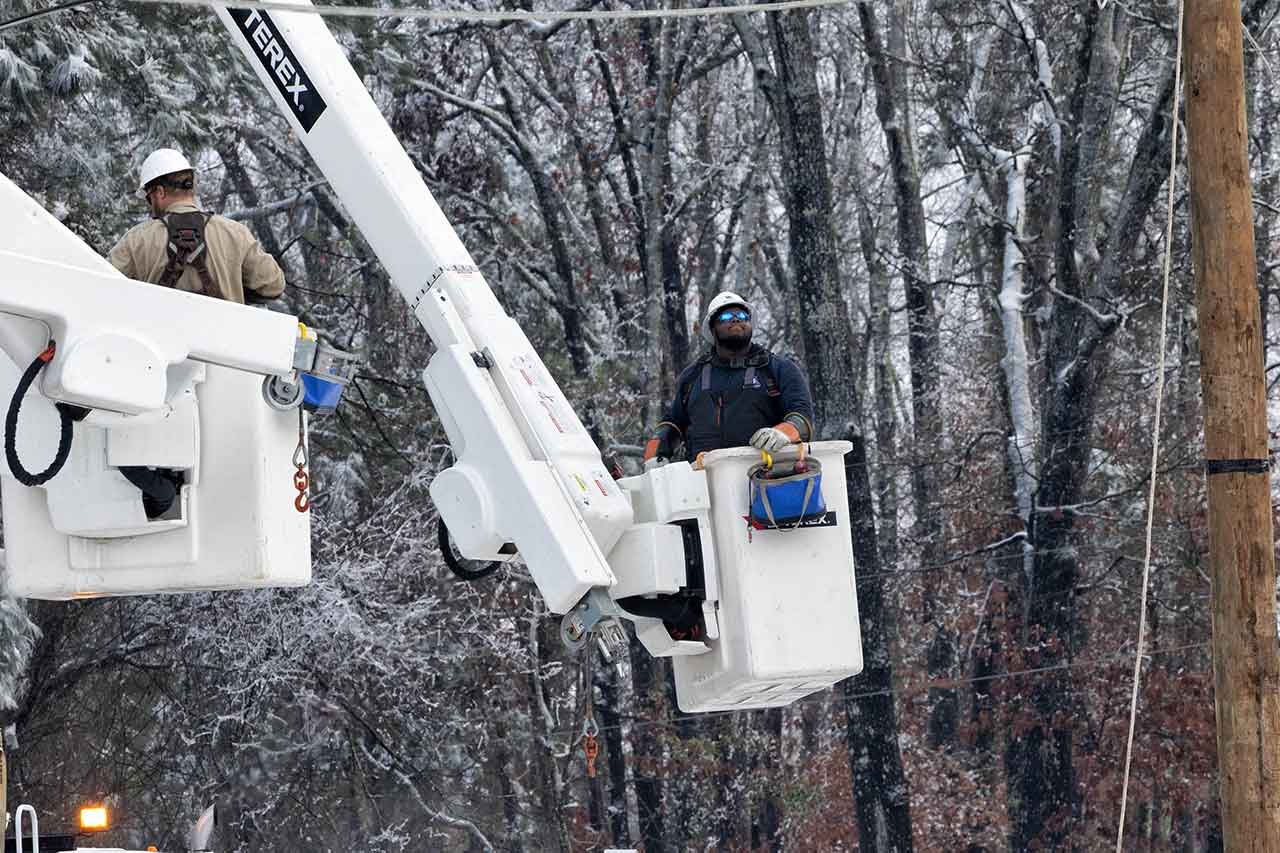
Restoration efforts are well underway following the recent severe winter weather, which continues to disrupt customers’ lives primarily in Louisiana and Mississippi. We have restored nearly 50% of all Entergy customers across the system, and work continues in the hardest-hit areas, which are expected to be restored this weekend.
Safety is our core value and always comes first. Then, restoring power is the top priority and first order of business. We assemble and organize the workforce needed to restore service safely and quickly to all customers.
While warming conditions support restoration progress, they also expose the full extent of the damage for the first time, including weakened trees, compromised poles and stressed power lines.
Crews are working in extremely hazardous conditions, including uncovering energized power lines hidden beneath layers of ice and snow. As damage assessments continue, workers are replacing broken utility poles, reattaching downed and damaged wiring, and repairing or replacing crossarms that support power lines.
The storm disrupted electrical service for approximately 171,200 customers across our service territory. As of 5 p.m., approximately 78,330 customers (47%) impacted by this storm have been restored.
Approximate outages (as of 5 p.m.):
| Operating company | Current Outages | Peak Outages | Restored | % Restored |
| Louisiana | 64,040 | 91,490 | 27,450 | 30% |
| Mississippi | 28,830 | 67,670 | 38,840 | 57% |
| Note: The figures above may include outages not related to the storm. | ||||
Estimated restorations
Restoration crews continue to make progress, but conditions remain dangerous and unpredictable as ice-related hazards persist and new risks emerge daily. Lingering ice continues to threaten both workers and the public, even as weather conditions improve.
Estimated restoration times are based on current conditions and may change as crews gain access to affected areas and complete repairs. We ask the public to be mindful that ice storms are unique weather events. Even after the storm has moved through, lingering ice can continue to stress power infrastructure and cause delayed damage.
Updated estimated restoration times reflect these evolving challenges and unfavorable conditions.
- Louisiana: More detailed restoration timelines by parish can be found at Entergy.com/StormCenter.
- Mississippi: More detailed restoration timelines by city can be found on the View Outage map alert banner.
Louisiana and Mississippi were hardest hit.
Northern Louisiana, particularly along the I-20 corridor including Ouachita, was hit hard by ice and freezing rain, while parts of Mississippi, from Southaven to Natchez, also experienced severe winter conditions.
Accessibility challenges such as icy road conditions and freezing temperatures may affect our ability to reach some areas of our territory and could delay damage assessment and restoration in those communities.
In Louisiana and Mississippi:
- As of Jan. 28, at 1 p.m., distribution damage assessments show we have approximately 1,420 poles, 5,050 spans of wire and 340 transformers damaged.
- As of Jan. 28, at 11:30 a.m., transmission damage assessments show approximately 10 substations, 20 transmission lines and 270 miles of lines are out of service. Approximately 40 substations and 20 transmission lines have been returned to service.
The winter weather’s impact:
The recent winter storm brought extreme challenges to our service area, significantly slowing restoration efforts.
According to preliminary reports from the National Weather Service:
Significant ice accumulation occurred in a corridor from Northeast Louisiana and Southwest Mississippi. The hardest-hit corridor—from Richland Parish through East Carroll Parish in Louisiana and into Sharkey, Issaquena, Holmes, Leflore, Carroll, and Grenada counties in Mississippi—experienced up to one inch of ice accumulation.
This heavy ice caused severe tree damage and structural impacts, creating widespread debris and blocked access routes, making it difficult for crews to reach affected areas.
For reference:
- A 1/8 inch of ice accumulation can cause small limbs and lines to become coated and may cause outages due to breaking limbs hanging overpower lines.
- A 1/4 inch of ice accumulation can worsen conditions. Younger evergreen trees will start to become so heavy that they may lean onto distribution lines, causing more outages.
- A 1/2 inch of ice accumulation on power lines can add 500 pounds of extra weight resulting in extended outages.
- A 1 inch of freezing rain accumulation and above, substantial devastation of the overhead distribution system will occur.
The storm also brought significant sleet accumulation, with up to 6–7 inches reported in Arkansas and widespread totals of 2–5 inches across Southeast Arkansas and Northwest Mississippi. This heavy sleet led to structural collapses, including carports, sheds, and gas station awnings.
In addition, the region experienced extreme cold conditions, with temperatures dropping as low as 11°F at Bluff Lake and ranging from 12–15°F across much of Mississippi and Louisiana.
Our crews are working long hours restoring service to customers as safely and as quickly as possible.
Workforce mobilization ramped up quickly, starting with more than 4,000 workers on Jan. 23. By Jan. 24, that number grew to 9,400, including 4,800 mutual assistance and contract resources and peaked on Jan. 25 with more than 10,000 workers, including 4,900 mutual assistance and contract resources.
As restoration progressed and some areas were fully restored, the workforce was strategically reduced and reallocated to the hardest-hit regions, reflecting the transition from widespread response to targeted restoration efforts in Louisiana and Mississippi.
As of Jan. 28, at 5 p.m., we have approximately 6,710 restoration workers in place or mobilizing to restore service for customers across Louisiana and Mississippi, including 4,860 mutual assistance and contract resources brought on specifically to assist in restoration. These resources include company employees, contractors and mutual aid resources numbering approximately:
- 3,880 in Louisiana
- 2,830 in Mississippi
We restore power as quickly as it is safe to do so.
We begin restoring power to customers as safely and quickly as possible after the storm has passed, and the restoration process is done in an orderly, deliberate manner. This starts with assessing the damage and then repairing power plants, transmission lines and substations and then the poles and wires in your neighborhood.
We restore lines serving large areas of customers, and then we restore neighborhoods. This returns power to the largest number of customers in the shortest amount of time.
Some homes and businesses take longer, as individual customer homes or businesses with damage are often the most time-consuming repairs.
- Some customers may notice that the other side of the street from them has power but their side doesn’t. This could mean that the two sides of the street are served by different parts of the electrical grid.
- Occasionally we’ll restore power to an area only to find another issue. This may require us to turn off the power again in order to complete additional repairs. We will also make initial repairs in some areas in order to get the power flowing to as many customers as possible. We then have to go back, take customers out of service, and complete more long-term repairs.
Customers should stay aware and stay safe.
There are various warming centers open across Mississippi, North Louisiana and Texas for those in need of shelter and warmth. Customers are encouraged to tune into their local media stations for more information.
To help customers stay warm and safe, Entergy Louisiana. is coordinating with local and state officials to support warming centers across impacted areas. If you plan to visit a warming center, please call 211 ahead of time to confirm availability.
Customers can learn more about preparation and safety information on the company’s Storm Center website.
We’re here to help
Our partnership with the American Red Cross is helping to provide shelter, food, water, supplies and volunteers to communities impacted by the winter storm. Our annual $250,000 disaster relief grant enables the American Red Cross to respond to storms and disasters across our service territory.
Our support across the region:
- Arkansas: Red Cross chapters actively monitored the situation following the winter storm. With resources ready to be deployed, the Red Cross was prepared to respond to community needs in coordination with emergency management partners.
- Louisiana: The Red Cross and its partners provided support to 21 shelters across the state. Supplies such as blankets, comfort kits, cots, water, and snacks were pre-positioned to help those in need. Additionally, Entergy employee volunteers underwent training to assist as shelter workers as demand increased.
- Mississippi: In Lee, Bolivar, and Wilkinson counties, the Red Cross opened three shelters. These shelters provided assistance to residents impacted by the cold weather and power outages, with a steady increase in the number of individuals seeking shelter. Essential supplies and food were maintained at all locations, while teams developed feeding strategies for the surrounding rural areas.
- Texas: The American Red Cross supported nine shelters throughout Southeast Texas.
To help customers during the extremely cold temperatures expected into next week, we have paused disconnects for non-payment through Feb. 2. If conditions improve sooner, some areas may resume normal operations earlier.
We are committed to delivering affordable, safe power to the communities we serve and helping customers manage their electric usage to generate savings on their bill. For customers struggling to pay their bill, we offer payment arrangements and flexible payment options to help them pay their energy bill. Customers are encouraged to visit BillToolkit.entergy.com for additional resources. They can also reach out to us to manage their account online at myEntergy or by calling 1-800-ENTERGY (1-800-368-3749) for assistance.

