
We continue to make steady progress, restoring service for more than 75% of our customers, but conditions remain dangerous and unpredictable as ice-related hazards persist and new risks emerge daily. Freezing temperatures and high winds could impact restoration efforts throughout the weekend.
Safety is our core value and always comes first. Then, restoring power is the top priority and first order of business. We assemble and organize the workforce needed to restore service safely and quickly to all customers.
The storm disrupted electrical service for approximately 171,200 customers across our service territory. As of 6:45 a.m., approximately 132,750 customers (78%) impacted by this storm have been restored.
Approximate outages (as of 6:45 a.m.):
| Operating company | Current Outages | Peak Outages | Restored | % Restored |
| Louisiana | 23,490 | 91,490 | 68,000 | 74% |
| Mississippi | 14,960 | 67,670 | 52,710 | 78% |
| Note: The figures above may include outages not related to the storm. | ||||
We’ve made steady progress restoring service to our customers. We know that if you are still without power, you want your power restored as quickly as possible.
Estimated restoration times are based on current conditions and may change as crews gain access to affected areas and complete repairs. We ask the public to be mindful that ice storms are unique weather events.
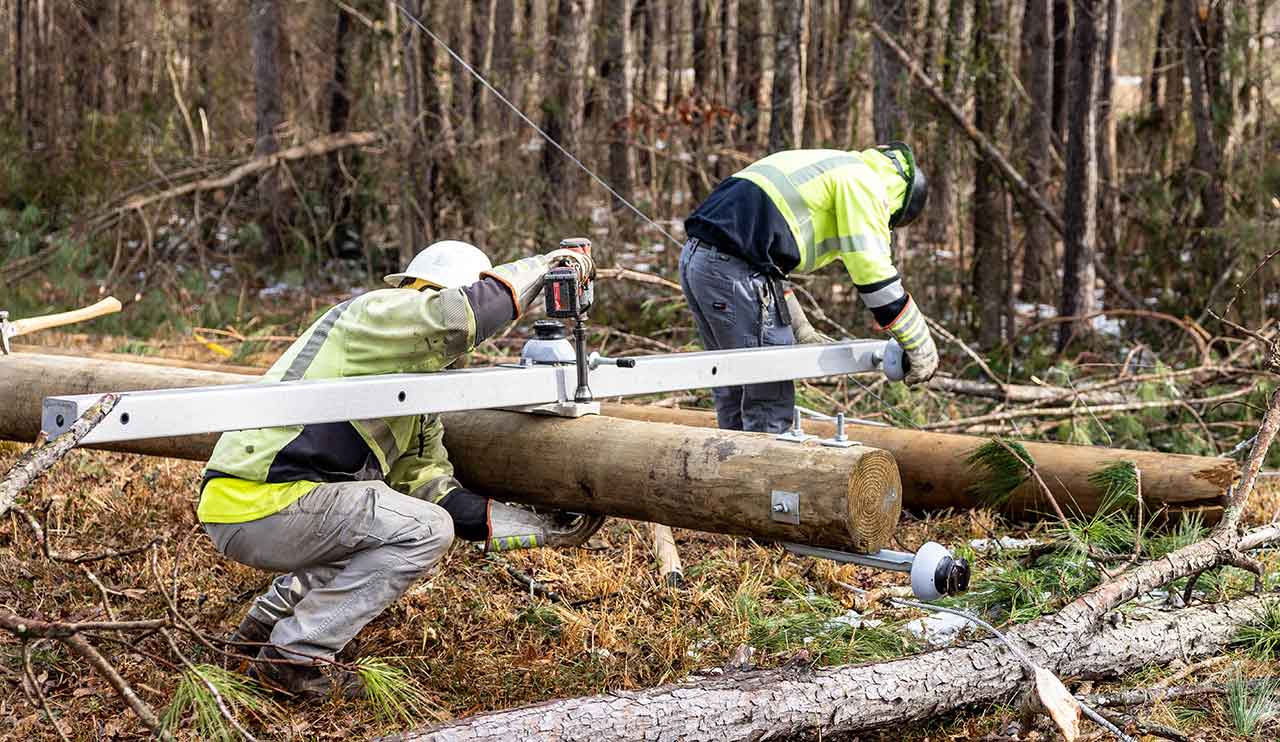
Crews are working in extremely hazardous conditions, including uncovering energized power lines hidden beneath layers of ice and snow, replacing broken utility poles, reattaching downed and damaged wiring, and repairing or replacing crossarms that support power lines.
While lineworkers are restoring power in the field, our logistics and support teams are working behind the scenes to keep restoration moving. This includes delivering materials to staging areas, deploying generators to critical facilities and arranging lodging for restoration workers.
Gusty winds are expected across southeast Arkansas and Mississippi beginning Friday evening continuing through Saturday, Jan. 31. The strongest winds will occur Saturday morning through early afternoon, with widespread gusts of 30–40 mph across Mississippi and 25–35 mph in far southeast Arkansas. Winds will begin increasing overnight, with gusts of 25–30 mph spreading into southern Arkansas and 30–35 mph across northern and central Mississippi by early morning. Conditions will peak between 6:00 a.m. and noon Saturday, before gradually subsiding later in the day.
For the safety of our crews, we cannot use our bucket trucks until sustained winds are less than 30 mph.
Entergy Louisiana impacts and updates
Significant progress continues as crews work through challenging and dangerous conditions. Outages are down to approximately 23,490 customers as of 6:45 a.m., from a peak of 91,490. Freezing temperatures could impact restoration efforts throughout the weekend.
- As of Jan. 31, at 6:00 a.m., restoration resources are approximately 4,620 in Louisiana, including company employees, contractors and mutual aid resources.
- As of Jan. 30, at 9:00 p.m., distribution damage assessments show we have approximately 920 poles, 2,970 spans of wire and 210 transformers damaged.
As of Jan. 30, at 11:30 a.m., transmission damage assessments show:
- Zero substations out of service, with 14 returned to service
- One line out of service, with 14 returned to service
- Approximately 20 miles of lines out of service
- More detailed Louisiana restoration timelines by parish can be found at our Storm Center website.
- In the most heavily impacted and hard-to-access areas, crews continue to discover additional damage caused by fallen trees, adding to the already significant totals identified during initial assessments. These restorations are extremely labor- and time-intensive, often requiring specialized off-road equipment and the replacement of multiple poles and spans.
For example, in the Warden area of Richland Parish, 75 utility poles must be replaced to restore power to a single group of 110 customers. This work requires approximately 20 crews working a day and a half to complete. Situations like this illustrate why restoration in some areas is taking longer despite significant progress overall.
To provide additional support while we work to restore service, Entergy Louisiana has opened Customer Information Centers in areas heavily impacted by the recent winter storm through Jan. 31.
At these centers, customers can receive the latest outage and restoration updates, learn about available assistance programs and community resources, charge mobile devices and speak directly with Entergy representatives.
The Customer Information Centers are located at:
- West Monroe Community Center – 400 S. 5th St, W. Monroe, LA 71292 (open 8 a.m. – 5 p.m.)
- Bastrop City Hall – 202 E Jefferson Ave Bastrop, LA 71220 (open 8 a.m. – 5 p.m.)
Entergy Mississippi impacts and updates
Entergy Mississippi’s storm team continues working to restore power as temperatures and hazardous conditions continue to affect communities across the company’s service territory. Outages are down to approximately 14,960 customers as of 6:45 a.m., from a peak of 67,670. Freezing temperatures and high winds could impact restoration efforts throughout the weekend.
- As of Jan. 31, at 6 a.m., restoration resources are approximately 2,760 in Mississippi, including company employees, contractors and mutual aid resources.
As crews complete restoration in one area, they move to support crews in other parts of our service territory. There are now almost 700 lineworkers working in hard-hit areas such as Grenada, Winona and Batesville.
- As of Jan. 30, at 9 p.m., distribution damage assessments show we have approximately 1,280 poles, 5,200 spans of wire and 280 transformers damaged.
- As of Jan. 30, at 11:30 a.m., transmission damage assessments show:
- Two substations out of service, with 31 returned to service
- Four lines out of service, with 13 returned to service
- Approximately 105 miles of lines out of service
Detailed Mississippi restoration timelines by city can be found on the View Outage map alert banner.
- Customers in the Grenada and surrounding areas may extend beyond Sunday.
- Please be aware that roads may be hazardous or closed during restoration efforts. Road conditions and closure information can be found here from Mississippi Department of Transportation.
Entergy Mississippi is committing $25,000 to provide critical relief to families and individuals affected by the recent winter storm that caused hazardous conditions and widespread power outages across the state.
Some of the organization’s response efforts include opening warming shelters, where they are providing cots, blankets, and comfort kits, serving more than 1,000 additional meals, and distributing relief supplies, such as water, tarps, cleanup kits, and recovery tools.
Our crews are working long hours restoring service to customers as safely and as quickly as possible.
Workforce mobilization ramped up quickly, starting with more than 4,000 workers on Jan. 23. By Jan. 24, that number grew to 9,400, including 4,800 mutual assistance and contract resources and peaked on Jan. 25 with more than 10,000 workers, including 4,900 mutual assistance and contract resources.
- As restoration progressed and some areas were fully restored, the workforce was strategically reduced and reallocated to the hardest-hit regions, reflecting the transition from widespread response to targeted restoration efforts in Louisiana and Mississippi.
- As of Jan. 31, at 6 a.m., we have approximately 7,380 restoration workers in place or mobilizing to restore service for customers across Louisiana and Mississippi, including 5,490 mutual assistance and contract resources brought on specifically to assist in restoration.
- We reallocate resources necessary to support crews already working restoration efforts in the harder-hit communities to start restoring power as safely and quickly as possible.
- To support the safety of our workforce and avoid fatigue, individuals should not work more than 16 hours in a 24-hour period and should never work more than 13 days in a row without a 24-hour rest period. This allows our restoration crews to get adequate rest and safely restore power when working.
We restore power as quickly as it is safe to do so.
We know being without power can be very frustrating for you, especially with extreme cold temperatures and arctic winds moving into the area this weekend. We understand how difficult it is to wait for power so you can get your lives back to normal.
Occasionally we’ll restore power to an area only to find another issue. This may require us to turn off the power again in order to complete additional repairs. We will also make initial repairs in some areas in order to get the power flowing to as many customers as possible. We then have to go back, take customers out of service, and complete more long-term repairs.
For example, crews in Louisiana had to restore power five separate times in one area due to ongoing damage uncovered during repairs. Situations like this can extend restoration timelines and lengthen workdays, encroaching on mandatory rest requirements for the safety of restoration workers.
Cold weather restoration is handled differently.
We use a methodical and calculated process in bringing customers back online after an outage in very cold weather, regardless of whether the initial cause of the outage was specifically weather-related. For more information on how we restore power during extreme winter weather events, visit our Storm Center website.
Cold load pickup is the phenomenon that takes place when a distribution circuit is re-energized following an extended outage of that circuit.
- It is referred to as cold load pickup because the power supply has been unavailable for a period of time, so the load has reached a “cold” state before being re-energized.
- Protective relay device settings were adjusted ahead of the cold weather moving into the service territory to help account for cold load pickup conditions should an outage occur.
- Engineering teams will monitor equipment and adjust protective relay settings throughout the cold weather event in response to the cold weather.
If an outage should occur, customers can assist by turning off or unplugging their electric appliances during the outage so they don’t all restart immediately as power is restored.
Galloping lines are a rare occurrence:
- When cold, icy weather strikes, our transmission lines can experience galloping, which is the slow, “skipping rope” motion of power lines.
- Galloping occurs when rain freezes to the power lines, and then steady winds cause adjacent lines to move and sometimes contact one another. This can cause an outage.
- Some compare this phenomenon to an airplane, where the ice freezes to the wire, creating a wing-type effect and making the lines move up and down. Wind blows across the conductor, which creates lift. With the right conditions, this will cause the lines to gallop.
- Minor galloping generally has no negative effect, but moderate galloping can cause adjacent conductors to contact and cause a fault. If severe enough the conductor can cause serious structural damage.
- While we can’t prevent lines from galloping, there are a number of ways our engineers try to prevent the impact of galloping lines. This includes controlling the tension in the conductor during the initial installation and installing dampers at certain locations on the line. Selecting the damper location is normally done using software that considers conductor size, span lengths and tension.
Monitoring energy usage
Extremely cold weather across our region is expected to drive increased energy usage over the next few days. Entergy continues to closely monitor the weather, our equipment and grid conditions. We are taking the appropriate steps to ensure reliable delivery of power to our customers.
The cold weather has caused MISO, the electric grid operator for the central United States, to extend the cold weather and conservative operations alerts effective until Feb. 1.
We continue to work closely with MISO to monitor grid conditions and prepare generators accordingly. We are prepared to address the anticipated demand.

